Kuzmarov‘s books are all available for purchase on Amazon.com.
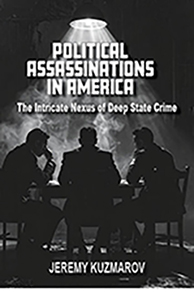
Political Assassinations in America: The Intricate Nexus of Deep State Crime
As Black revolutionary H. Rap Brown famously declared during the 1967 racial riots in Detroit, “Violence is as American as cherry pie.” While violence is evident in its endless wars waged around the globe and in gun violence and mass shootings in American cities, the extent of its eruption into domestic politics remains largely unacknowledged. Ten American presidents have been the targets or apparent targets of assassins, as have five presidential candidates. Eight governors, seven U.S. Senators, nine U.S. House members, eleven mayors, a U.S. Treasury Secretary and seventeen state legislators have also been victims of political violence. So have the country’s first Secretary of Defense, a White House Counsel and a Secretary of Commerce, a CIA biochemist, numerous journalists and witnesses to state crimes, and even Beatles singer, John Lennon. Then there’s Epstein and Charlie Kirk.
Successful, professional, credentialed historians continue to attribute known politically-related assassinations in this country to deranged loners―or “lonely oddballs with a firearm fixation.” Nothing else to see here, folks. Cases closed.
Political Assassinations in America aims to debunk this ahistorical record. It shows that the struggle to gain or preserve political power in America has resulted in conspiracies that led to targeted assassinations―just like in other countries―which in turn have resulted in major policy shifts that were usually negative. A pattern of intelligence agency engagement can be discerned in many of the assassinations while a dense network of interconnected players across a range of high-profile crimes emerges, exposing the dark, thorough and very intricate complexity of American secret operations.
America will not look the same to you after reading this book. Think of it as a companion piece to the Epstein files.

Syria: Anatomy of Regime Change
With a Foreword by Oliver Stone:
In December 2024, Syria’s president Bashar al-Assad departed for Russia after militia forces took Damascus. An Al-Qaeda affiliated group led by Abu Mohammed Al-Jolani (aka Ahmed Hussein al-Sharaa) took power. New York Times columnist Thomas L. Friedman hooted that it was the “biggest…most game-changing event in the Middle East in the last 45 years.” Yet until then, Al-Jolani was wanted for terrorism and had a U.S. State Department $10 million bounty on his head since 2017.
The media-established story of popular “rebels” triumphing over “evil” has since dominated. Washington’s role in this long-standing regime change operation was erased.
This is the first comprehensive account of the U.S. regime change operation in Syria dating back decades. The goal was to end Syria’s nationalist economic program, its support for the Palestinians, and its steadfast opposition to U.S. and Israeli hegemonic designs in Western Asia.
The methods utilized fit a long-standing U.S. regime-change playbook applied worldwide. Key aspects include a protracted demonization campaign, imposition of crippling economic sanctions, and CIA financing of rebel groups under the billion-dollar Operation Timber-Sycamore.
.
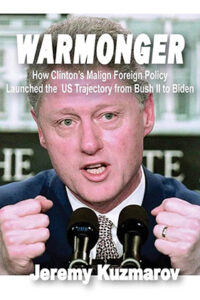
Warmonger: How Clinton’s Malign Foreign Policy Launched the US Trajectory from Bush II to Biden
During the 2016 presidential election, many younger voters repudiated Hillary Clinton because of her husband’s support for mass incarceration, banking deregulation and free-trade agreements that led many U.S. jobs to be shipped overseas. Warmonger: How Clinton’s Malign Foreign Policy Launched the Trajectory from Bush II to Biden, shows that Clinton’s foreign policy was just as bad as his domestic policy. Cultivating an image as a former anti-Vietnam War activist to win over the aging hippie set in his early years, as president, Clinton bombed six countries and, by the end of his first term, had committed U.S. troops to 25 separate military operations, compared to 17 in Ronald Reagan’s two terms. Clinton further expanded America’s covert empire of overseas surveillance outposts and spying and increased the budget for intelligence spending and the National Endowment for Democracy (NED), a CIA offshoot which promoted regime change in foreign nations.
Obama’s Unending Wars: Fronting the Foreign Policy of the Permanent Warfare State
Many academics consider Obama to have been a master foreign policy strategist and shrewd practitioner of the art of realpolitik. This book demonstrates, however, that Obama in reality helped to institutionalize a permanent warfare state that resulted in gross human rights violations and contributed to America’s strategic decline. His perpetuation of the War on Terror created more enemies and prompted the United States to lose influence in the Middle East. His Pivot to Asia policy intensified prospects for regional war while his unnecessary and willful military intervention destroyed Libya and drew the Russians in to protect Bashir al-Assad who won Syria’s civil war. The Obama administration’s heavy-handed interference in Ukraine led to effective Russian counter-moves, promoting a strategic alliance with China and regional integration that is moving the world towards multi-polarity.
Read the book reviews:
Modernizing Repression: Police Training and Nation-Building in the American Century (Culture, Politics, and the Cold War)
As American troops became bogged down first in Iraq and then Afghanistan, a key component of U.S. strategy was to build up local police and security forces in an attempt to establish law and order. This approach, Jeremy Kuzmarov shows, is consistent with practices honed over more than a century in developing nations within the expanding orbit of the American empire. From the conquest of the Philippines and Haiti at the turn of the twentieth century through Cold War interventions and the War on Terror, police training has been valued as a cost-effective means of suppressing radical and nationalist movements, precluding the need for direct U.S. military intervention and thereby avoiding the public opposition it often arouses.
Read the book reviews:
- book reviews on the University of Massachusetts Press website
- Reviewed by Kyle Longley, Arizona State University
- Reviewed by Hochmüller Markus
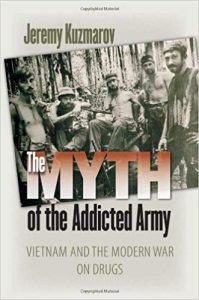
The Myth of the Addicted Army: Vietnam and the Modern War on Drugs (Culture, Politics, and the Cold War)
The image of the drug-addicted American soldier―disheveled, glassy-eyed, his uniform adorned with slogans of antiwar dissent―has long been associated with the Vietnam War. More specifically, it has persisted as an explanation for the U.S. defeatthe symbol of a demoralized army incapable of carrying out its military mission.
Yet as Jeremy Kuzmarov documents in this deeply researched book, popular assumptions about drug use in Vietnam are based more on myth than fact. Not only was alcohol the intoxicant of choice for most GIs, but the prevalence of other drugs varied enormously. Although marijuana use among troops increased over the course of the war, for the most part it remained confined to rear areas, and the use of highly addictive drugs like heroin was never as widespread as many imagined.
Read a book review on the Monthly Review.
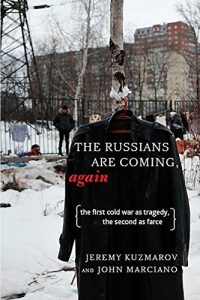
The Russians Are Coming, Again: The First Cold War as Tragedy, the Second as Farce
Karl Marx famously wrote in The Eighteenth Brumaire of Louis Napoleon that history repeats itself, “first as tragedy, then as farce.” The Cold War waged between the United States and Soviet Union from 1945 until the latter’s dissolution in 1991 was a great tragedy, resulting in millions of civilian deaths in proxy wars, and a destructive arms race that diverted money from social spending and nearly led to nuclear annihilation. The New Cold War between the United States and Russia is playing out as farce – a dangerous one at that. The Russians Are Coming, Again is a red flag to restore our historical consciousness about U.S.-Russian relations, and how denying this consciousness is leading to a repetition of past follies.
Kuzmarov and Marciano’s book is timely and trenchant. The authors argue that the Democrats’ strategy, backed by the corporate media, of demonizing Russia and Putin in order to challenge Trump is not only dangerous, but also, based on the evidence so far, unjustified, misguided, and a major distraction.
Read the book review:
- Reviewed by Paul Buhle.